Teeth Braces in Multan: Is It Too Late for Adult Braces?
Most people who ask about teeth braces in Multan as adults have been thinking about it for years. Something made it urgent again: a wedding photograph, a lower front tooth that has drifted further out, or a dentist mentioning that the way you bite is wearing one side down. And then comes the hesitation, which is almost always the same sentence. Isn't it too late at my age?
It is not. Teeth move because of the bone around them responding to steady pressure, and that process does not switch off at a particular birthday. What does change with age is the planning, the timeline and the limits of what braces alone can achieve, and those are worth understanding before you commit.
The Bite Problems Adults Usually Come In With
Adult cases tend to look different from teenage ones. These are the patterns we see most often in clinic:
- Lower front teeth that have crowded or rotated in the last ten years, after being straight at twenty
- One side of the mouth doing all the chewing, because the other side does not meet properly
- Front teeth that do not touch at all, so you tear food with the side teeth
- A tooth that feels taller than the others and takes the first contact when you close
- Flattened, shortened edges on the front teeth from years of an uneven bite
- Gums receding on one or two teeth that sit outside the arch
- A gap that opened after a back tooth was removed and never replaced
If you recognize several of these, the question is less whether braces can help and more what they should be asked to do.
What Actually Changes After the Jaw Stops Growing
This is the honest part, and it is not what most marketing says.
In a growing child, an orthodontist can influence how the jaws themselves develop. In an adult, the jaws are set. Teeth can still be moved through bone at any age, but the skeleton they sit in cannot be redirected. For most adults that makes no practical difference, because most cases are about tooth position rather than jaw position. For a minority with a significant skeletal discrepancy, braces alone will camouflage the problem rather than correct it, and a full correction would need surgery alongside orthodontics.
A few other practical differences:
- Treatment often runs a little longer. Bone remodels more slowly in adults, so the same movement may take a few months more than it would in a teenager.
- Gum health governs everything. Teeth cannot be moved safely through inflamed gums or reduced bone. Any gum disease is treated and stabilized first, without exception.
- Old dentistry complicates the picture. Crowns, bridges, implants and heavily filled teeth all behave differently. An implant does not move at all, so it becomes a fixed point the plan has to work around.
- Retention is lifelong, not temporary. Adult teeth drift back more readily. Retainers are part of the treatment, not an optional extra at the end.
Aga Khan University Hospital's orthodontic guidance makes the same point plainly: there is no age limit for orthodontic treatment, though growth modification is only possible while a patient is still growing.
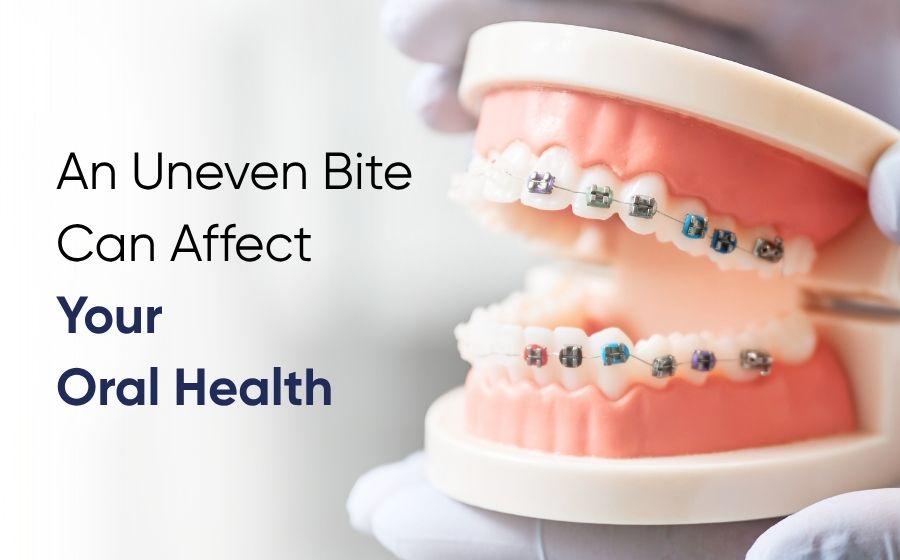
Is an Uneven Bite Only a Cosmetic Problem?
No. An uneven bite concentrates force on a few teeth instead of spreading it across all of them, and over years that shows up as flattened edges, cracked cusps, teeth that become sensitive to cold, and fillings or crowns on the overloaded side that keep failing. Crowded teeth are also harder to clean, so decay and gum inflammation cluster in the same tight contacts.
Plenty of adults start treatment for appearance and finish it grateful for the chewing.
Which Appliance Suits an Adult Case
For adults the choice usually comes down to how visible the appliance is and how complex the movement needs to be:
- Metal braces. The most predictable for complex movements and the most economical. Modern brackets are considerably smaller than the ones you remember from school.
- Ceramic braces. Tooth-colored brackets, far less noticeable at conversational distance. Slightly more fragile and usually a longer treatment.
- Self-ligating braces. No elastic ties, so fewer adjustment visits, which suits adults who cannot get to the clinic every month.
- Clear aligners. Removable and discreet, well suited to mild and moderate crowding, and popular with professionals. They depend entirely on you wearing them 20 to 22 hours a day. Clear aligners are not the right tool for every adult case, and your orthodontist will say so if yours is one of them.
There is no universally better option. There is the one that matches your case, your work and your budget.
When Braces Are Not the Right Answer Yet
We will advise waiting, or a different plan altogether, when:
- Gum disease is active and the supporting bone is still being lost
- There is untreated decay, which must be restored before brackets go on
- You grind heavily at night and the cause has not been addressed
- Your concern is one slightly chipped front tooth, where bonding would do in a single visit what braces would take two years to achieve
- You are not in a position to commit to retainers afterward, in which case the result will not hold
Saying this at the consultation rather than halfway through treatment is the whole point of the assessment.
How Long Will Treatment Take at My Age?
Most adult cases run 18 to 24 months, with simple alignment sometimes finishing inside a year and complex bite correction reaching three. Adjustment visits fall every four to six weeks. Age shifts that range a little, but case complexity moves it far more than your date of birth does.
What to Expect When You Start
- Consultation and records. A clinical examination, photographs, and X-rays to check bone levels and root positions before anything is planned.
- Treatment plan. You are shown what is achievable, what is not, how long it will take and what it costs in writing, before you agree to anything.
- Preparation. Any scaling, fillings or gum treatment is completed first.
- Fitting. Brackets are bonded and the first wire placed. The appointment takes around an hour, and teeth feel tender for several days afterward.
- Adjustments. Every four to six weeks, each taking fifteen to thirty minutes.
- Removal and retention. Braces come off, a retainer is fitted the same day, and the wear schedule is explained.
What Do Braces Cost in Multan?
At DentoCorrect, teeth braces start from PKR 220,000 for metal, PKR 250,000 for ceramic and PKR 350,000 for self-ligating. These are complete treatment figures rather than deposits, and installment plans are available.
For context, directory listings for Multan in 2026 commonly quote metal braces from roughly PKR 40,000 to PKR 150,000 and ceramic considerably higher, with individual clinics advertising starting prices between PKR 80,000 and PKR 300,000. That spread is real, and it almost never describes the same package. A figure at the very bottom of that range typically covers the brackets and nothing else.
Before comparing two quotes, ask each clinic whether the number includes the consultation and X-rays, every adjustment visit for the full treatment, repairs if a bracket comes loose, the retainers at the end, and review appointments afterward. Our detailed breakdown sits on the dental braces treatment page, and there is a fuller cost guide in our braces price guide for Pakistan.
Adult Braces at Our Bosan Road Clinic in Multan
Our Multan clinic is on the Northern Bypass, 1 KM Bosan Road, New Shalimar Colony, and treats patients from Multan City, DHA, Cantt, Bosan Road and Gulgasht Colony. We are open Monday to Saturday, 10:30 AM to 9:00 PM, closed Sunday.
Adults make up a large share of the orthodontic cases here, and the scheduling reflects that: evening adjustment appointments, and self-ligating options for patients who travel for work and cannot attend monthly. Treatment is planned and monitored by PMDC-registered dentists.
If you would rather talk it through before committing to anything, call [+92 349 2807711](tel:+923492807711) or see the Multan clinic page for directions.
Frequently Asked Questions
Is 45 too old to start braces?
No. Teeth respond to orthodontic force at any age, provided the gums and supporting bone are healthy. What decides suitability is the condition of your gums and existing dental work, not the year you were born. Your dentist will check bone levels on an X-ray before planning anything.
Will braces work if I have crowns and bridges already?
Usually, with adjustments to the plan. Brackets bond less strongly to porcelain than to enamel, so the surface is prepared differently. A bridge spans several teeth as one unit and an implant will not move at all, so both become fixed points the orthodontist designs the plan around.
Do adults need teeth removed more often than teenagers?
Not necessarily, but it is discussed more often, because adult crowding cannot be relieved by guiding jaw growth. Where space is short, the alternatives are extraction, slight enamel reduction between teeth, or widening the arch. Your orthodontist will explain which your case allows before starting.
Can I have braces if my gums have receded?
Sometimes, and carefully. Recession itself is not a barrier, but active gum disease is. The gums are treated and stabilized first, lighter forces are used, and the gum level is monitored throughout. Moving teeth through inflamed gums accelerates bone loss, so this sequence is not negotiable.
How noticeable are adult braces at work?
Ceramic brackets are hard to notice beyond a metre or so, and clear aligners still less so. Metal braces are visible, which is the trade-off for their predictability and lower cost. Most adults report the self-consciousness fading within the first two or three weeks.
What happens if I stop wearing the retainer after a year?
The teeth drift, and adult teeth drift faster than teenage ones because the fibres around them have been in their old position for decades. Most relapse happens in the first two years but continues slowly for life. Nightly retainer wear long term is the usual recommendation.
Book an Adult Braces Consultation in Multan
If you have been putting this off because of your age, an assessment will give you a straight answer about what is possible in your case. Call our Bosan Road clinic on [+92 349 2807711](tel:+923492807711) or book an appointment.