Teeth Whitening in Faisalabad: Even Out Patchy, Uneven Tooth Color
In photographs your teeth are not simply yellow. They are uneven: chalky white marks across the front two, a duller band near the gum, perhaps one tooth that sits a shade darker than everything beside it. That patchiness is the reason most people start looking into teeth whitening in Faisalabad, and it is also the reason an off-the-shelf kit so often disappoints. Whitening lifts the whole tooth together. If the color was uneven to begin with, lifting everything evenly can leave it just as uneven, only brighter.
The good news is that uneven color has specific causes, and most of them have a specific answer.
What Your Particular Kind of Patchiness Looks Like
Before anything is bleached, it helps to recognize which pattern you have. In clinic these are the ones we see most:
- Chalky white flecks or streaks, often on the upper front teeth, which look whiter than the rest of the tooth rather than darker
- A dull band along the gum line while the biting edges still look bright
- One single tooth noticeably darker, often a front tooth that was knocked years ago
- Grey or brown horizontal lines running across several teeth at the same height
- Dark edges between the teeth where chai and paan staining has settled into the contact points
- Patchy brightness that appeared after a home whitening kit, worse than before you started
These do not share a cause, and they do not share a fix. A dentist looking at your teeth in good light can usually tell them apart in a minute or two.
Why White Spots Get Whiter, Not Better
The chalky white marks are the most misunderstood. They are usually either dental fluorosis, from taking in more fluoride than needed while the adult teeth were forming in childhood, or enamel hypoplasia, where the enamel did not mineralize fully in the first place.
In both, the spot is more porous than the enamel around it. Bleach reaches it faster and lifts it faster. So the spot brightens ahead of the rest of the tooth, and for the first few days after whitening the contrast can look worse, not better. It usually settles as the surrounding enamel catches up and rehydrates, but it rarely disappears on bleaching alone.
What often does work is evening the background: whiten the whole tooth so the gap between spot and surroundings narrows, then treat whatever is left with microabrasion or a small composite repair. That sequence matters. Bleaching first, then repairing, means the repair is matched to your final shade rather than your old one.
When One Tooth Is Darker Than the Rest
A single dark tooth is a different problem entirely, and bleaching the outside of it will not touch the cause. The darkness is usually coming from inside, after an old injury killed the pulp. The tooth may feel completely normal and still be discolored for this reason.
Treating it means dealing with the inside first, usually root canal treatment, followed by internal bleaching placed within the tooth rather than on it. External whitening on a dark non-vital tooth tends to brighten the eight teeth around it and leave the dark one standing out more than before.
If you have one tooth that is darker and you have never had it checked, have it X-rayed before any whitening is planned.
What Chai, Coffee and Paan Actually Do
Surface staining is the most straightforward kind, and the kind whitening handles best. Chai with milk, coffee, cola and tobacco all deposit chromogens onto the enamel surface and into the microscopic pits in it. Paan and supari stain faster and deeper than any of them.
The tell is where it sits: surface stain concentrates along the gum line, between the teeth, and in the grooves, which is why it looks patchy rather than uniform. A good deal of this is not stain at all but stained tartar, which no bleach will lift. That is why a professional cleaning is done first in most cases, and why some people find their teeth look several shades better after scaling and polishing alone, before any whitening gel is opened.
Who Should Wait, and Who Should Not Whiten at All
Whitening is not right for everyone, and a clinic that starts without checking is not doing you a favor. Your dentist will usually postpone or advise against it if:
- You have untreated decay or a leaking filling, which lets gel reach the inside of the tooth
- Your gums are inflamed or bleed when you brush, which makes the process uncomfortable and the result uneven
- You are pregnant or breastfeeding, where the usual advice is to wait
- You are under 18, while the pulp chambers are still large
- Your front teeth are mostly crowns, veneers or composite fillings, which do not change color at all
That last point catches people out. If your upper front teeth carry old composite fillings, whitening the natural enamel around them will make those fillings look darker and more obvious. They would then need replacing to match. It can be the right plan, but you should know before you start, not after.
In-Clinic or Take-Home Trays for Uneven Color
For patchy teeth specifically, the two approaches behave differently.
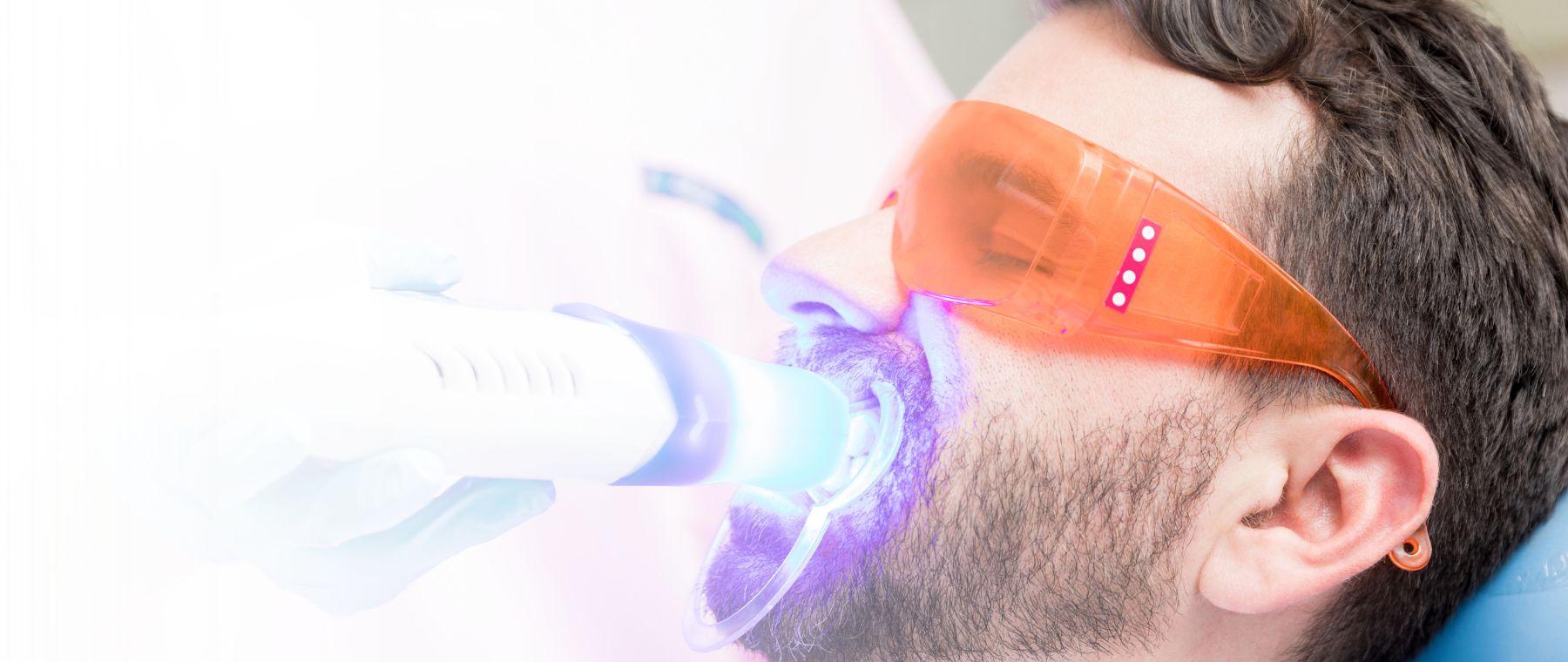
In-clinic whitening uses a stronger gel under direct supervision, with the gums isolated behind a protective barrier. It is quicker, and the dentist can watch how individual teeth respond and adjust as they go, which matters when the teeth are not starting from the same place.
Custom take-home trays use a milder gel over one to two weeks. The slower rise can suit uneven cases, because the porous spots and the normal enamel have more time to even out, and the trays can be worn on some teeth more than others.
Many patchy cases do best with a combination: one in-clinic session to do the heavy lifting, then trays to settle the result. Your dentist will assess which your enamel suits.
What Happens at Your Appointment
- Examination and shade record. Decay, gum health and existing restorations are checked, and your starting shade is recorded against a guide so progress can be measured rather than guessed.
- Cause mapping. The dentist identifies which kind of discoloration each affected tooth has. This is the step that decides the plan.
- Cleaning. Tartar and surface deposits are removed. Some patients stop here, satisfied.
- Protection. A barrier is placed over the gums and a retractor keeps the lips and cheeks away from the gel.
- Application. The gel is applied in timed cycles, with the response checked between each one.
- Review. The result is compared against your starting shade, and any microabrasion or composite work is planned for a later visit, matched to the new color.
How Much Does Teeth Whitening Cost in Faisalabad?
At DentoCorrect, in-office whitening starts from PKR 35,000 for a single session, PKR 40,000 with scaling included as a package, and PKR 50,000 for a multi-session plan where the staining needs more than one visit.
For context, directory listings for Faisalabad in 2026 commonly show whitening quoted anywhere from roughly PKR 5,000 to PKR 30,000, a spread wide enough to tell you the quotes are not describing the same thing. At the low end that figure is often a polish, not a bleaching procedure. Ask what is actually included: the examination, the cleaning beforehand, how many sessions, and whether take-home trays are part of it.
For patchy cases, also ask what happens if the spots are still visible afterward, and whether the microabrasion or composite repair is quoted separately. Our pricing in full sits on the teeth whitening treatment page.
Teeth Whitening in Faisalabad at Our People's Colony Clinic
Our Faisalabad clinic is at 564-B People's Colony, near Saleemi Chowk on Satiana Road, open Monday to Saturday, 10:30 AM to 9:00 PM and closed on Sunday. A female dentist sees patients here; mention it when you book.
Because uneven color needs to be diagnosed rather than guessed at, whitening here always starts with an examination and a shade record, not a gel. If the honest answer is that bleaching will not even out your particular pattern, you will be told that at the first visit.
Call [+92 346 1762762](tel:+923461762762) to arrange an assessment, or see directions and timings on the Faisalabad clinic page.
Frequently Asked Questions
Why do my white spots look worse right after whitening?
The spots are more porous than the enamel around them, so they dehydrate and brighten faster during treatment. The contrast peaks in the first few days and usually softens over one to two weeks as the enamel rehydrates and the surrounding shade catches up.
Can whitening even out teeth that are patchy from fluorosis?
It can narrow the gap but rarely closes it completely. Whitening lifts the background shade so the marks stand out less. Mild remaining spots are often finished with microabrasion or a thin composite repair, planned after whitening so the shade match is made against your final color.
Will whitening fix the dark line near my gums?
Often yes, if that band is stain or tartar. If the darkness is the root surface showing through because the gum has receded, bleaching will not change it, since root dentine does not respond like enamel. Your dentist can tell which it is by examination.
I used a home kit and now my teeth are blotchy. Can that be corrected?
Usually. Blotchiness from an ill-fitting tray is uneven gel contact rather than damage, and it typically evens out over a few weeks. If it has not settled, a supervised course with properly fitted trays generally corrects the pattern. Have the enamel checked before repeating any home kit.
Does whitening work on the brown lines running across my front teeth?
Horizontal bands across several teeth at the same height usually formed while those teeth were developing, so they sit within the enamel rather than on it. Whitening lightens them but seldom removes them. Deeper or wider bands are more often treated with composite bonding or veneers.
How long will an even result last in Faisalabad?
With regular chai, most people see noticeable re-staining within a year and keep the result longer with a periodic top-up. Rinsing with water after chai, and keeping six-monthly cleanings, makes more difference than any whitening toothpaste.
Book a Whitening Assessment in Faisalabad
If your teeth are uneven rather than simply dull, the first step is finding out why. Call our People's Colony clinic on [+92 346 1762762](tel:+923461762762) or book an appointment for a shade assessment.