Wisdom Tooth Removal in Islamabad: Swollen Gums Around a Wisdom Tooth?
It is usually around 11 at night when the message comes in: the gum behind the last lower molar has puffed up, it hurts to close the teeth, and there is a bad taste that will not rinse away. The short version: this is almost always pericoronitis, an infected flap of gum over a wisdom tooth that has only partly come through. Tonight, warm salt-water rinses and a painkiller will calm it. Tomorrow, a dentist needs to clean under that flap. If the swelling has reached your cheek or throat, or you cannot open your mouth properly, do not wait for morning. This article walks through the flare hour by hour, then through what wisdom tooth removal in Islamabad actually involves, because the flap will very likely act up again while the tooth stays.
Why the gum behind your last molar flares at night
A lower wisdom tooth that comes through at an angle rarely clears the gum completely. A hood of soft tissue, the operculum, stays draped over the back half of the crown. Food packs under it every time you eat, a toothbrush cannot reach it, and the upper wisdom tooth bites straight down on it when you chew. The pocket under that hood is warm, wet and sealed, which is everything bacteria want. Patients describe it the same way at the F-8 clinic almost every week, "daant ke peechay masoora sooj gaya hai", and most have had a milder version before and ignored it.
One check in the mirror with a phone torch. A soft red cushion on top of a tooth you can only half see is the flap. If instead the tooth in front has a dark hole or a broken corner and the pain shoots when you drink something cold, the problem may be decay in the second molar, a different conversation (see our guide to root canal treatment in Islamabad).
Hour zero to hour 24: what actually helps tonight
Nothing you do at home tonight will cure pericoronitis. The aim is to lower the bacterial load under the flap and get to the morning in reasonable shape.
- Rinse with warm salt water, half a teaspoon in a glass, held at the back of the mouth on the sore side for 30 seconds. Repeat every two to three hours while awake, head tilted toward the sore side so the water reaches under the hood.
- Take a painkiller you have used safely before. Ibuprofen tends to do more for gum swelling than paracetamol, but skip it if you have a stomach ulcer, kidney problems or are pregnant. Never put a crushed tablet on the gum; aspirin burns the tissue.
- Brush the area gently with a soft brush. It will bleed a little. Leaving the plaque there because it hurts is how the flare gets worse.
- Eat soft, cool food on the other side. Avoid anything with seeds (sesame naan is the classic offender).
- Sleep with an extra pillow. Swelling drains a little better with the head up.
Not on that list: clove oil in the pocket, a hot compress on the cheek (outside heat can push a spreading infection outward), or forcing the mouth open to "stretch" the jaw.
What salt water and painkillers cannot do
Salt water lowers the bacteria at the surface. It does not clear the compacted food wedged deep under the flap, and it does nothing about the upper tooth biting on it. A painkiller hides the pain; it does not shrink the pocket.
The other habit we see in Islamabad is buying amoxicillin or metronidazole at the pharmacy without a prescription. Sometimes it quietens a flare. More often it blunts the symptoms for a week while the infection carries on under the gum, and the next episode arrives harder. Antibiotics have a place in pericoronitis, but only when the infection is spreading, and they are a bridge to treatment, not the treatment.
When wisdom tooth swelling is an emergency
Most flares stay local: a sore flap, a bad taste, discomfort when you bite. Some do not. Go to a hospital emergency department the same night, not the dentist next morning, if any of these are true:
- The swelling is visible from outside, on the cheek or under the jawline, and is growing
- You cannot open your mouth wide enough to fit two fingers stacked between your front teeth
- Swallowing is painful or feels obstructed, or your voice sounds muffled
- You have a fever, chills or feel generally unwell
- The swelling is tracking toward the eye or down the neck
WebMD's patient guidance lists face swelling, swollen lymph nodes and jaw spasm as signs of a possibly life-threatening infection (WebMD, Pericoronitis), and that is not an exaggeration; a lower wisdom tooth infection can track into the neck within a day or two. For F-sector residents the nearest emergency departments are PIMS in G-8 and Shifa in H-8.
Day one at the clinic: what happens at the first visit
If you have messaged us overnight, the first visit is about settling the flare, not pulling the tooth. At the F-8 Markaz branch it usually looks like this:
- A look at the flap and at the upper wisdom tooth. Very often the upper tooth has over-erupted and its cusps are chewing a groove into the swollen gum below; we may smooth them or, where it serves no purpose, remove it the same day.
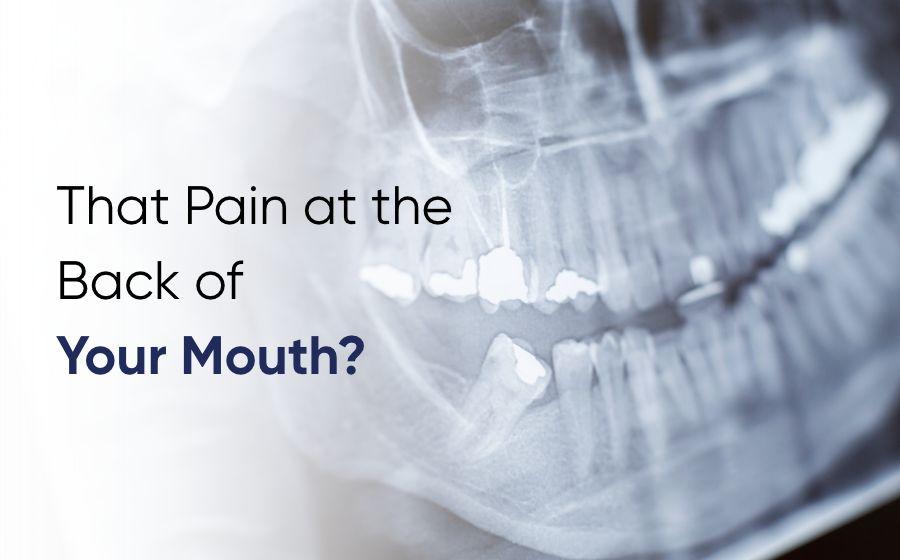
- An OPG X-ray, which shows the angle of the lower tooth, how much sits under bone, and where the nerve canal runs. This decides whether removal later is a short visit or a longer surgical one.
- Irrigation under the flap with a fine syringe of chlorhexidine or saline. Relief is often immediate, and people are surprised by how much comes out.
- Antibiotics only if there is spreading swelling, fever or difficulty opening.
Then we talk about the lower tooth. This is the honest part. We do not usually remove a lower wisdom tooth at the peak of an acute infection; the anesthetic works less well in inflamed tissue and the risk of dry socket rises. We settle it first, typically over five to seven days, and plan the removal after that.
Removal is not automatic either. If you are 17 to 20, the tooth is upright on the X-ray and has room to finish coming through, the flap may disappear on its own within months, and we will say so. We hold off, or refer to a hospital unit, when a patient has uncontrolled diabetes, is on blood thinners without a plan from their physician, or when the roots wrap around the nerve canal.
Why the flare keeps coming back while the tooth stays
Patients often ask whether one good clean will fix it. Sometimes, for the upright tooth that is still erupting. For the angled tooth, the pocket re-forms within weeks because the anatomy has not changed, and each episode leaves the flap thicker and harder to clean.
The pattern is predictable: a mild flare in exam season that is ignored, a worse one in Ramadan when dehydration and broken sleep lower the defenses, and a third in the week before a wedding, when nobody wants surgery. By the second episode most dentists will advise wisdom tooth removal, and that is our view too. Trimming the flap (an operculectomy) rarely lasts on a tilted tooth; the gum grows back over the same unreachable corner.
The extraction appointment, honestly
Fear is the reason most people in Islamabad put off wisdom tooth removal, so here is what it is like rather than what the brochure says.
You are numbed with a local anesthetic injection near the back of the lower jaw. That injection is the uncomfortable part, and it lasts a few seconds. After five to ten minutes your lip, chin and tongue on that side feel thick, and from there you should feel pressure and movement but not sharp pain. If you do, say so; more anesthetic can be given.
For a tooth that is partly through and only mildly tilted, the removal often takes 20 to 30 minutes. For a tooth with more of its crown under bone, the gum is lifted, a little bone is removed with a water-cooled handpiece (the noise bothers people more than any sensation does), and the tooth is divided into pieces so it comes out with less force. Those appointments run closer to 45 minutes. The NHS puts most wisdom tooth removals at no more than 40 minutes and says most people are back to normal activities the next day, with one to three days off for harder cases (NHS, Wisdom tooth removal).
Afterward: dissolving stitches, gauze for 30 minutes, written instructions. Numbness lasts two to three hours, soreness peaks that evening, and swelling peaks at 48 to 72 hours. Most office workers take the next day off and are back on day two. No hard rinsing, smoking or straws for the first 24 hours; those dislodge the clot and cause dry socket, the one complication that genuinely hurts.
What does wisdom tooth removal in Islamabad cost?
At DentoCorrect, surgical extraction, which covers impacted and partly erupted wisdom teeth, starts from PKR 28,000, and a simple extraction of a tooth that is fully through starts from PKR 8,000. The examination and treatment plan are free, so you know which bracket you are in before anything is decided.
Across Islamabad, quotes for surgical wisdom tooth removal run from roughly PKR 15,000 to PKR 45,000 and above, based on clinic listings on WhatClinic and local guides. The PKR 200 to PKR 4,000 figures on directory sites are consultation fees, not the surgery. At the cheap end, what tends to be missing is the OPG, the follow-up visit, the medicines, and a clinician who divides the tooth rather than levering it out whole.
Not sure whether what you have is a flare, a decayed back tooth or something that needs the hospital tonight? Send a photo of the area and tell us how long it has been swollen on WhatsApp, and our team will tell you what the usual next step is.
Wisdom tooth removal in Islamabad at our F-8 Markaz clinic
The DentoCorrect Islamabad branch is on the first floor of Kashif Plaza, F-8 Markaz, a short walk from the district courts. Patients come from F-10, F-11, G-9 and G-10, from E-11, and from offices in Blue Area who book the 6 PM and 7 PM slots so they do not lose a working day. The clinic is open 10:30 AM to 9:00 PM, Monday to Saturday, closed Sunday. Call the branch on +92 347 4623620 or see directions on the Islamabad clinic page.
If the tooth that hurts is a broken or decayed molar rather than a wisdom tooth, our guide to tooth extraction in Islamabad covers when a tooth is beyond saving.
What people in Islamabad ask us about a swollen wisdom tooth
Can a swollen gum over a wisdom tooth settle on its own?
A mild flare can calm down in three to five days with rinsing and careful brushing, and for an upright tooth that finishes erupting it may not return. For a tilted tooth the flap stays, the pocket refills and the flare comes back, usually within months and usually worse.
How long does a pericoronitis flare last?
Untreated, a typical episode runs five to ten days. With the flap irrigated at a clinic, most people feel better within 24 hours and are comfortable by day three. Still swollen after a week, or getting bigger? Something else is going on and you need to be seen.
Should I just take an antibiotic from the pharmacy?
We would not. A course bought over the counter may dull a local flare, but it does nothing about the trapped debris and makes the infection harder to treat if it spreads. Antibiotics belong with facial swelling, fever or difficulty opening, and then you need to be examined, not just medicated.
Does the upper wisdom tooth have to come out as well?
Often, yes. The upper third molar is usually what traumatizes the flap, and once the lower tooth is gone it has nothing to bite against and tends to over-erupt. Upper wisdom teeth are quick to remove and heal within days, so we frequently take both on the same side in one visit.
Book before the next flare, not during it
The best time to have this tooth assessed is the week after the swelling goes down, before the next episode decides the date for you. The examination and OPG review at F-8 Markaz is free, evening slots run until 9 PM Monday to Saturday, and a quiet, uninfected tooth comes out far more comfortably than an angry one.
Call the branch on +92 347 4623620, message us on WhatsApp with a photo, or book an appointment online for this week.