
White spots
Acid has started to pull minerals out of the enamel, leaving chalky patches. No hole yet, and this is the only stage that can reverse.
How to reverse it
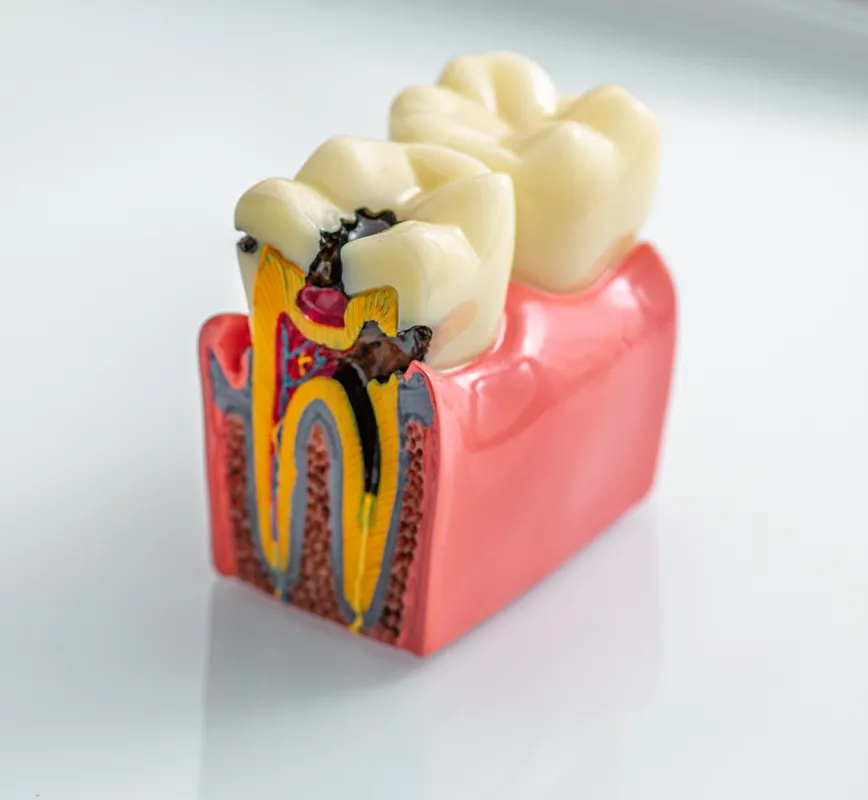
Tooth decay is damage caused when bacteria in plaque turn sugar into acid that dissolves the enamel, leaving a cavity. It starts as a chalky white spot that can still be reversed with fluoride, then becomes a brown or black hole that needs a filling. Left untreated, it reaches the nerve and needs a root canal or extraction.
Early decay is easy to miss because it rarely hurts. These are the signs to look and feel for:
Decay between the teeth often shows nothing at all until it is deep. A check-up with an X-ray finds it while a small filling will still do.
Book a Free ConsultationDecay moves inwards in stages. The earlier it is treated, the smaller and cheaper the fix:
Acid has started to pull minerals out of the enamel, leaving chalky patches. No hole yet, and this is the only stage that can reverse.
How to reverse itThe surface breaks down into a small brown or black cavity. Usually painless, and fixed with a small filling.
Tooth-coloured fillingsDecay reaches the softer layer underneath and spreads faster. The tooth turns sensitive to sweets and cold.
Fillings and crownsThe pulp becomes inflamed, causing throbbing pain, often at night. A filling alone is no longer enough.
Root canal treatmentBacteria reach the root tip and form a pocket of pus, with swelling, a bad taste and sometimes a fever.
Tooth infection guideSo much of the tooth is lost that it breaks or can’t be saved, and it has to be removed and replaced.
Tooth extractionDecay needs three things: bacteria, sugar and time. These habits give it all three:
It is how often, more than how much. Sugary chai through the day, biscuits, mithai and soft drinks keep teeth under acid attack for hours.
The sticky film of bacteria turns sugar into acid. Missing the gum line and the gaps between teeth gives it a place to stay.
Each snack or sweet drink starts a new 20 to 30 minutes of acid. Grazing all day never lets the enamel recover.
Saliva neutralises acid and repairs early damage. Medicines, mouth breathing and long fasts that dry the mouth raise the risk.
Deep pits in back teeth and overlapping teeth trap food where a toothbrush can’t reach.
Fluoride hardens enamel. Without fluoride toothpaste and regular check-ups, small cavities grow unnoticed.
Only at the very start. Once enamel has broken into a hole it can't grow back, however well you brush:
Home remedies such as clove oil can ease the pain of a cavity for a while, but they don't remove the decay. Book a check-up.
These habits stop new cavities and can reverse decay while it is still at the white spot stage, for adults and children alike:

Already have pain or a hole? Prevention won't fix an existing cavity. Our guide to toothache explains what to do until you see a dentist.
The treatment depends on how deep the decay has gone. After an examination and an X-ray, these are the treatments we use at DentoCorrect:


The decay is removed and the tooth sealed with a composite filling matched to its shade. Most cavities are fixed this way in one visit.

When decay has destroyed a large part of a tooth, a crown covers and strengthens what is left so it doesn’t crack.

When decay reaches the nerve, the infected pulp is cleaned out and sealed, saving the tooth and ending the pain.

A tooth too broken down to save is removed, and an implant replaces it so the teeth beside it don’t drift.
DentoCorrect is Pakistan's ISO-certified, multi-city dental clinic network with qualified dentists at every location. Here is what sets us apart:
Experienced dentists at every DentoCorrect clinic
Careful check-ups and X-rays find cavities while they are still small
Strict safety and sterilisation protocols at every clinic
Fillings and root canals first; extraction only as a last resort

You'll know what's needed and what it costs before we begin

Lahore (Johar Town, Gulberg & DHA), Islamabad, Rawalpindi, Karachi, Faisalabad, Peshawar, and Multan
Only at the very first stage. Chalky white spots where the enamel has started to soften can harden again with fluoride toothpaste, less sugar and good cleaning. Once there is an actual hole, the tooth can't grow back, and the cavity needs a filling before it gets bigger.
No. There is no worm. The old belief comes from the dark, hollow look of a decayed tooth. Decay is caused by bacteria that turn sugar into acid and dissolve the tooth. Treating it means removing the decay and filling the tooth, not killing a worm.
Early decay looks like a chalky white or light brown patch. As it grows it turns brown or black and becomes a small hole or a dark line around an old filling. Decay between the teeth often can't be seen at all and only shows on an X-ray.
No. Dark spots in the grooves of back teeth can be stain from tea or food. But a black spot can also be decay that is spreading underneath, so it is worth having it checked, especially if it catches food or feels sensitive.
There's no safe waiting time. Small cavities often grow slowly over months without pain, then speed up once they reach the softer inner layer. By the time it hurts, the decay is usually near the nerve, so the treatment is bigger and costs more.
Usually not. The tooth is numbed with a local anaesthetic first, so you feel pressure and vibration but not pain. The tooth may be a little sensitive to cold for a few days afterwards.
Yes. Baby teeth hold space for the adult teeth and decay in them can cause pain, infection and early loss. Children's cavities can also spread quickly because their enamel is thinner, so have them checked rather than waiting for the teeth to fall out.
The same bacteria and habits affect all your teeth, and decay between two teeth often damages both. Treating a cavity early and cutting down how often you have sugar protects the teeth around it.
It depends on the size of the cavity and the material used. A small tooth-coloured filling costs much less than a large one, a crown or a root canal, which is why treating decay early saves money. At DentoCorrect the dentist checks the tooth and tells you the full cost before starting.
In Urdu tooth decay is usually described as danton ka kharab hona or keera lagna (دانتوں میں کیڑا لگنا). Dentists call it dental caries.