
Dental Implants in Multan: Stop the Jaw Bone Loss a Gap Causes
"Jagah khaali hai, dard to nahi hota." The space is empty and it does not hurt, so why spend on it? We hear it often, usually from someone who lost a lower molar two or three years ago and has chewed on the other side since. The gap is quiet. The bone under it is not: with no root to work it, the ridge thins, fast in the first six months and slowly for years afterward. Dental implants in Multan are planned from an X-ray and a 3D scan of exactly that bone, and an implant is the only replacement that puts chewing load back into it. Here is what the dentist reads on those images.
Why the jaw bone shrinks once the root is gone
The part of the jaw that holds the teeth exists for the teeth. Each root hangs in its socket on a thin ligament, and every bite tugs that ligament against the socket wall. Bone keeps what is used. Take the root out and that strip of bone has lost its job, so the body starts clearing it away, beginning with the thin outer wall on the cheek side.
It goes sideways first. A systematic review of 20 human studies put the loss at about 3.8 mm of width against roughly 1.2 mm of height by six months, with around a third of the width already gone at three months and a slower decline after that (Tan et al., 2012).
You cannot feel any of this. The gum closes over in a few weeks and looks pink and healthy, so a three-year-old gap and a three-month-old gap look much the same from above. On the scan, the older ridge is often closer to a knife edge.
The six readings taken before dental implants in Multan are planned
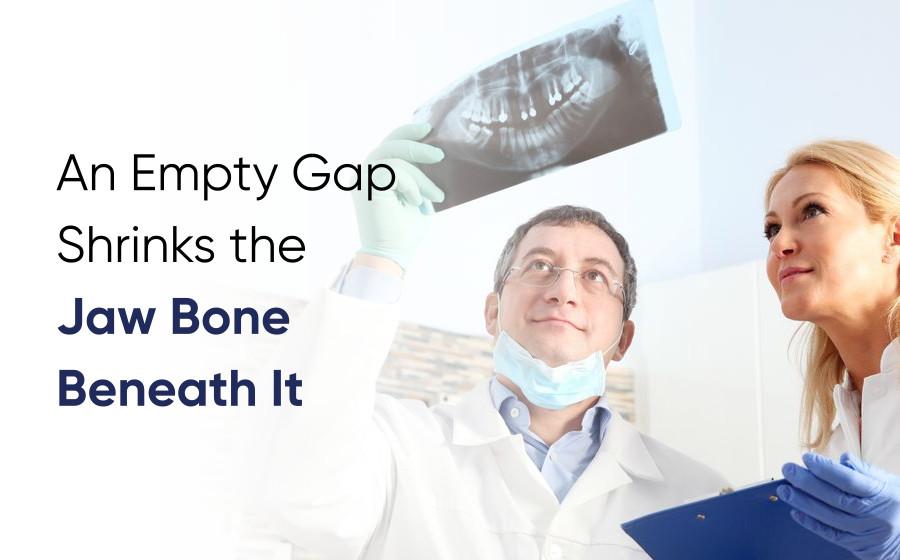
The first image is usually a panoramic X-ray (an OPG, the wide film on our banner), which lays both jaws out flat. It shows heights but not thickness, so implant planning adds a 3D scan (CBCT) that slices the ridge like a loaf of bread. Six readings come off the two:
- Ridge width. A standard implant is about 4 mm across and needs bone on both sides, so many dentists look for roughly 6 to 7 mm. This is the reading an old gap most often fails.
- Ridge height. How much bone lies between the crest of the ridge and the first structure that must not be touched.
- Distance to the nerve canal, in the lower jaw. The nerve that gives feeling to the lower lip and chin runs in a canal that shows as a gray channel on the film. The implant has to stop short of it, usually by about 2 mm.
- Distance to the sinus, in the upper jaw. An air space sits above the upper back teeth. After an upper molar is lost its floor can drop into the bone the root used to occupy, so the ridge is squeezed from above as well.
- Tilt of the neighbors. The tooth behind a gap leans forward into it over the years, so a space that looks wide at the gum may be much narrower at the biting surface.
- The opposing tooth. With nothing to bite against, the tooth above or below grows toward the gap. In a study of 155 unopposed back-tooth sites, 83 percent showed over-eruption, in some cases by more than 5 mm (Craddock and Youngson, 2004).
The last two are the ones nobody expects. People come in to ask about bone and are shown an upper molar hanging two millimeters below its neighbors.
What each finding means: implant, graft, sinus lift or bridge
A straightforward implant
Width and height are both there, the neighbors are upright and the opposing tooth is where it should be. This is more often the picture when the tooth came out within the last year or so. One placement visit, three to four months for the bone to grip the implant, then the crown.
An implant with a small graft
The ridge is a millimeter or two short on the cheek side. The implant can usually still go in, with graft material packed against the thin wall at the same visit. That means more swelling but usually not extra months. A much thinner ridge is grafted first and left to mature for four to six months. Our earlier post on bone grafting explains the materials.
A sinus lift
Upper back teeth only. If the bone under the sinus is a few millimeters short, the sinus floor can often be raised through the implant site itself, in the same sitting. If very little height is left, graft is placed under the sinus lining through a small window in the side of the jaw, and the implant waits several months. It is a real operation and we describe it as one.
A bridge or partial denture instead
Sometimes the scan argues against an implant. The teeth either side already carry large fillings and would do better crowned anyway, the grafting needed is out of proportion to one back tooth, or your health rules surgery out for now. A bridge at DentoCorrect starts from PKR 28,000 and a partial denture from PKR 70,000; the crown and bridge page and the dentures page cover both.
Where tilt or over-eruption has closed the space, the leaning molar may need uprighting with braces or aligners first, or the over-erupted tooth reshaping to give the room back.
Does a bridge or a denture stop the bone loss?
No. A bridge and a denture replace the part of the tooth you can see, not the root. A bridge hangs a false tooth between two crowned neighbors, so the bite travels into their roots and the bone under the false tooth stays idle. A denture rests on the gum. Only an implant sits in the bone and passes chewing force into it.
That is why the ridge under a ten-year-old bridge has often sunk away from the false tooth, leaving a dark space that traps food.
Two honest limits. An implant does not bring back bone that has already gone; it holds what is there on the day it goes in, which is the whole argument for not waiting. And a little settling around the neck of the implant in the first year is normal, after which the bone around a healthy, well-cleaned implant usually stays steady.
Dental implant price in Multan, with and without a graft
At DentoCorrect a single tooth implant starts from PKR 80,000, an implant-supported bridge from PKR 200,000 per arch, and a full arch runs from PKR 500,000 to 1,500,000. The consultation is free. A graft or sinus lift is priced in the written plan and not before, because nobody can size it without the scan.
Multan listings on Oladoc and WhatClinic show one implant quoted from about PKR 60,000 to 300,000, and Marham's national guide adds PKR 20,000 to 120,000 for a bone graft. The low figures usually leave out the crown, the 3D scan or the graft.
If PKR 80,000 is out of reach this year, say so at the consultation. A bridge closes the gap for much less. It will not hold the bone, and we would rather you chose it knowing that than left the space open for three more years and needed a graft as well.
Already have an OPG or a scan, even an old one from the day the tooth came out? Send a photo of it on WhatsApp with how long ago the tooth was removed, and our team will tell you what the next step usually is.
How big an operation a single implant is
Smaller than the word "surgery" suggests, and for most people easier than the extraction that made the gap. That tooth was infected or broken, and the numbing had to work against inflamed tissue. An implant goes into quiet, healed bone.
It is done under local anesthetic, and one implant typically takes 45 to 90 minutes. You feel pressure and vibration. You hear more than you feel. Most patients report soreness and some swelling for two or three days, and many are back at work the next morning.
If it is the injection you dread, say so at the start. It changes how the appointment is run.
Is it ever fine to leave a gap?
Sometimes, yes. Wisdom teeth are not replaced. A second molar at the very back, with no tooth opposite it to drift, can often be left if you chew comfortably without it. And a space that has already closed to less than half a tooth is usually better left alone, or handled with orthodontics, than forced open for an implant.
There are also people we would not place an implant in until something changes:
- Anyone whose jaw is still growing, which usually means under 18 to 20.
- Patients with active gum disease. It is treated first, because the same infection can attack the bone around an implant.
- Patients with poorly controlled diabetes, until the readings are steadier.
- Heavy smokers who do not plan to stop around the surgery. Implants fail more often in smokers.
- Anyone who tells us they will not come back for reviews.
Where dental implants in Multan are planned: our Northern Bypass clinic
DentoCorrect Multan is on the Northern Bypass, 1 KM from Bosan Road, in New Shalimar Colony, within easy reach of Gulgasht Colony, Cantt and DHA Multan. The clinic is open 10:30 AM to 9:00 PM, Monday to Saturday, and closed on Sunday; the late slots suit anyone who would sooner come after the evening rush on Bosan Road than sit in it.
The branch number is +92 349 2807711. Directions are on the Multan clinic page, and the dental implants page lists the implant types we place.
What patients ask when they see their own X-ray
Can I still have an implant if the tooth came out years ago?
Usually, yes. Time alone does not rule it out; the scan decides. An older gap is more likely to need a graft first, but some ten-year-old gaps keep a wide ridge and some recent ones do not.
Can the jaw bone grow back on its own?
No. Once the ridge has thinned it stays thin, and calcium tablets do not rebuild it. Bone can be added with a graft, and an implant placed into that graft then gives it a reason to stay.
The tooth is coming out next week. What should I ask for?
First, ask whether it can be saved. A tooth kept with root canal treatment in Multan keeps its root, and the root keeps the bone. If it has to go, ask whether the socket can be filled with graft material on the day (socket preservation), which is meant to limit how much the ridge shrinks while you decide. Then book the implant assessment for two to three months later, not "sometime".
Have the gap measured before it narrows further
The bone changes fastest in the months straight after an extraction, so the useful week to have a gap measured is this one. The consultation for dental implants in Multan is free and ends with a written plan and its cost.
Call the Multan branch on +92 349 2807711, message us on WhatsApp, or pick an evening slot on the booking page. Bring any old X-rays you have. They show the dentist how much has changed.