
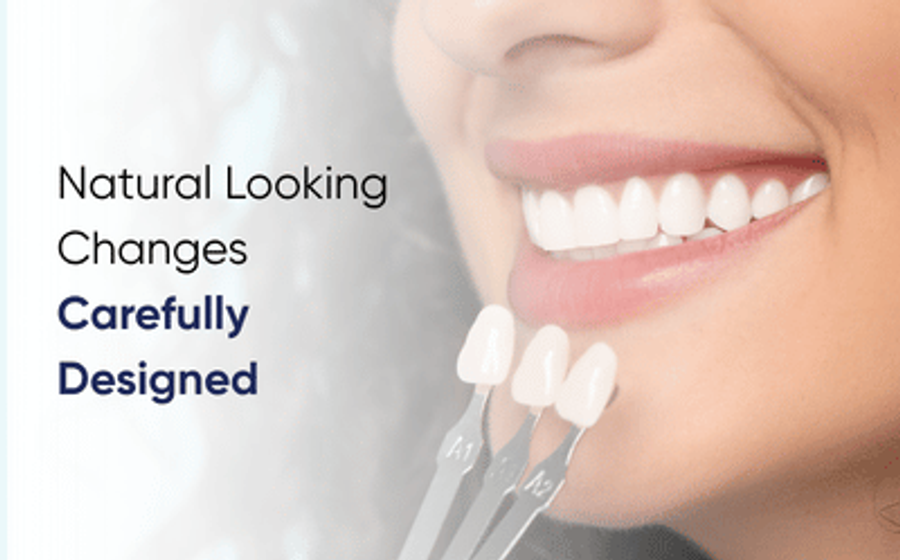
Dental Veneers in Karachi: Cover Stains Whitening Cannot Remove
There is a particular kind of disappointment that brings people to ask about dental veneers in Karachi. You spent money on whitening. Perhaps twice. The teeth lifted a shade, or they did not shift at all, and the grey band across the front teeth is exactly where it always was. Nobody explained why. The reason is almost always that the color is not sitting on the tooth, it is built into it, and no amount of bleaching reaches it. Veneers can solve that. But they are a permanent decision, and the right first step is working out what kind of discoloration you are dealing with.
Why your teeth did not respond to whitening
Whitening gel works by letting peroxide pass into the tooth and break apart the pigment molecules it finds there. That works beautifully on stain deposited from the outside, over years of chai, coffee and tobacco. It performs poorly, and sometimes not at all, when the color is part of the tooth's internal structure.
Clinical guidance is direct about the hardest version of this: routine bleaching cannot satisfactorily lighten dark tetracycline staining. If that is what you have, more sessions of the same treatment will not change the outcome. They will only make the teeth sensitive.
Which kind of discoloration do you actually have?
This is the question your dentist should answer before anything is recommended. Broadly there are two families, and they lead in different directions:
Extrinsic, sitting on the surface
- Chai, coffee and cola staining
- Tobacco, paan, gutka and chaalia, which are a significant cause of heavy anterior staining in Karachi
- Deposits trapped in tartar along the gum line
These respond well to scaling and polishing, and then to whitening. Veneers would be an expensive answer to a cleanable problem.
Intrinsic, built into the tooth
- Tetracycline staining — grey or brown banding from antibiotics taken in childhood or by the mother during pregnancy
- Fluorosis — white flecking through to brown mottling, from excess fluoride while the teeth were forming
- A single dark tooth after trauma — the nerve died and blood pigments stained the dentin from inside
- Enamel defects — thin or poorly formed enamel letting the yellow dentin beneath show through
- Age-related darkening — dentin thickens and yellows over decades while enamel thins
The last two in particular are why some people's teeth look darker each year despite careful hygiene.
The ladder: what to try before veneers
Good dentistry works upward from the least invasive option. In order:
- Scaling and polishing. Removes surface deposits and tartar. Sometimes that is the whole problem.
- Professional whitening. Effective for extrinsic staining and age-related yellowing. Our guide to teeth whitening covers what it realistically achieves.
- Internal bleaching. For one dark tooth after a root canal, the whitening agent is placed inside the tooth rather than on it. This can restore the shade without touching the outside at all.
- Microabrasion. For shallow fluorosis flecking, a fine abrasive polish can remove the affected surface layer.
- Composite bonding. Tooth-colored resin applied directly to mask discoloration. Reversible, cheaper, and a sensible trial before committing.
- Veneers. When the above cannot produce an acceptable result.
Published guidance places porcelain veneers precisely at that last rung: indicated for discolored teeth where microabrasion, bleaching and composite have already failed to give a satisfactory result. If a clinic offers veneers as the opening suggestion for mild staining, ask why the earlier rungs were skipped.
What a veneer is, and what it permanently costs you
A veneer is a thin shell bonded to the front of the tooth. To sit flush rather than bulge, it needs room, so a layer of enamel is removed first, typically in the range of 0.3 to 0.7 mm.
That enamel does not grow back. It is the single most important fact in this decision, and it has consequences worth stating plainly:
- The tooth will always need a covering from that point onward
- When a veneer eventually fails or chips, it is replaced, not simply removed
- Prepared teeth can be more sensitive to hot and cold for a period afterward
- Removing too much exposes dentin, where bonding is less predictable
None of that argues against veneers. It argues for being sure first. Where the staining is severe, veneers are a conservative answer compared with crowning the teeth, which removes far more tooth structure.
Composite or porcelain for a staining case?
- Composite veneers are built up directly in one visit, cost considerably less, and can be repaired. They do absorb stain over time, which matters if chai or paan is part of the picture, and they usually need replacing sooner.
- Porcelain veneers are made in a laboratory and bonded at a second visit. The color is fired into the ceramic, so it does not stain the way resin does, and the surface reflects light more like natural enamel. They cost more and take longer.
For deep tetracycline grey, porcelain is generally the more dependable choice. The ceramic can be layered to block the underlying shade, which composite struggles to do without looking thick or flat. Our dental veneers guide for Multan walks through the material comparison in more detail.
Can a single dark tooth be veneered on its own?
Yes, and it is one of the harder things to do well. Matching one veneer to seven surrounding natural teeth demands careful shade work, and the result depends on how the underlying dark tooth is masked. Two points worth knowing:
- Internal bleaching should usually be tried first. If it lifts the shade adequately, you keep the tooth intact.
- If the rest of your teeth will be whitened, that is done before the veneer is made, because the veneer is matched to the final shade and cannot be lightened afterward.
Who should not have veneers
- Anyone with active decay or gum disease. Both are treated and stable before cosmetic work begins.
- Heavy grinders. Ceramic chips under sustained grinding. If you clench at night, this is addressed first, and a night guard usually becomes part of the plan.
- Teeth with very large existing fillings. There may not be enough sound tooth left to bond to; a crown may be the more honest recommendation.
- Teenagers and young adults. The pulp sits closer to the surface in younger teeth, and the gum line is still settling.
- Anyone expecting a specific result from a photograph. Your face, lip line and remaining teeth determine what will look natural on you.
What happens at DentoCorrect, visit by visit
- Assessment. We identify what is causing the discoloration, check the gums and the bite, and tell you whether something further down the ladder would do the job.
- Smile design. Photographs, shade selection in daylight, and a preview of the proposed shape. You approve the plan before any tooth is touched.
- Preparation. Minimal enamel reduction and a scan or impression. Temporary veneers are fitted so you are never without front teeth.
- Fitting. The finished veneers are tried in and checked for shade and fit while still removable. Only once you are satisfied are they bonded.
- Review. A check a week or two later for the bite and the gum response.
Local anesthetic is used for the preparation visit, and most patients report mild sensitivity for a few days afterward rather than real discomfort.
Living with veneers in Karachi
- Paan, gutka and chaalia will stain composite veneers and the natural teeth beside porcelain ones. Porcelain holds its color; the surrounding teeth may not.
- Avoid biting hard objects directly with veneered front teeth, including ice and bottle caps.
- Keep scaling appointments. Veneer margins sit at the gum line and need professional cleaning.
- Use a night guard if you grind.
- Whitening does not work on veneers, so plan any whitening before they are made.
Well-maintained porcelain veneers commonly last upward of a decade; composite typically needs attention sooner.
Dental veneers in Karachi at our PECHS clinic
DentoCorrect Karachi — Shop No. 1, Family Heaven Apartments, PECHS. Call [+92 347 9904276](tel:+923479904276).
Our PECHS location is convenient for Tariq Road, Bahadurabad, Shahra-e-Faisal, Gulshan-e-Iqbal, DHA and Clifton. The clinic is ISO certified and staffed by PMDC-registered dentists, with shade matching done in natural light rather than under surgery lamps, which is the main reason veneers sometimes look right in the chair and wrong outside it.
Full directions are on our Karachi dental clinic page. If missing teeth are part of what you want addressed, our guide to dental implants in Karachi covers that side of things.
What veneers cost in Karachi
Veneers are priced per tooth, and the total depends on:
- The material, composite or porcelain
- How many teeth show when you smile, commonly six to eight rather than two
- Whether scaling, whitening, fillings or gum treatment are needed first
- The complexity of the shade match, which is higher for tetracycline cases
For context, published prices in Karachi in 2026 commonly run from roughly PKR 5,000 to PKR 15,000 per tooth for composite, and about PKR 25,000 to PKR 40,000 per tooth for porcelain, with premium ultra-thin systems quoted higher.
We give you an itemized quote per tooth in writing at the consultation, after we have seen what is actually causing the staining. The consultation itself is free, and installment plans are available for multi-tooth cases.
Frequently Asked Questions
Why did whitening not work on my teeth?
Most likely because your discoloration is intrinsic, meaning it sits within the tooth structure rather than on the surface. Bleaching gel reaches surface stain well but cannot satisfactorily lighten deep tetracycline banding or severe fluorosis. A dentist can usually tell which type you have by examining the pattern of the color.
Do veneers damage the teeth underneath?
Preparation removes a thin layer of enamel, roughly 0.3 to 0.7 mm, and that is permanent. The tooth stays healthy underneath when the veneer is well made and well maintained, but it will always need a covering from then on. That is why less invasive options should be ruled out first.
How many veneers will I need?
It depends on how many teeth are visible when you smile, not how many are stained. Treating two central teeth and leaving discolored neighbors on show rarely looks right. Six to eight upper veneers is a common plan. Your dentist will assess your smile line and tell you what is needed.
Will my veneers look obviously fake?
Not if the shade, shape and thickness are planned around your face rather than a template. Choosing a shade far brighter than your natural teeth and skin tone is what makes veneers announce themselves. We match in daylight and let you approve the preview before preparation.
Can veneers be whitened later?
No. Ceramic and composite do not respond to whitening gel. Any whitening of your natural teeth needs to happen before the veneers are made, so they can be matched to the final shade. Otherwise the natural teeth will lighten and the veneers will look darker by comparison.
Can I have veneers if I grind my teeth?
Often, but not before the grinding is addressed. Sustained clenching chips ceramic and shortens the lifespan of the work considerably. Your dentist will check for wear patterns, and a night guard is usually fitted as part of the treatment plan rather than as an afterthought.
Book a veneers consultation in Karachi
If whitening has already let you down, the useful next step is a diagnosis, not another product. We will tell you what kind of staining you have, whether something simpler would fix it, and what veneers would realistically achieve for your smile.
Call [+92 347 9904276](tel:+923479904276) or book an appointment online at our PECHS clinic. You can also read more about professional teeth whitening at DentoCorrect if surface staining turns out to be the real culprit.