Teeth Braces in Lahore: Correct Crowded, Overlapping Teeth
Crowding rarely arrives overnight. Most adults who ask us about teeth braces in Lahore say the same thing: the front teeth were a little uneven in their twenties, and somewhere along the way one tooth slid behind another and the smile stopped looking like theirs. Some have been quietly covering their mouth in photographs for years. The good news is that crowding is one of the most predictable things orthodontics corrects, at almost any age. The harder question is not whether it can be fixed, but which approach suits your bite, your budget, and how much of your day you are willing to give it.
Why are my teeth more crowded now than they were at twenty?
This is the question we hear most, and the honest answer is that teeth are not fixed in concrete. They sit in bone, held by a ligament, and they drift slowly throughout life. Several things push them together:
- Late lower incisor crowding. The lower front teeth tend to shuffle inward through the twenties and thirties, even in people who never had braces. It is common enough that orthodontists treat it as a normal aging pattern rather than a fault.
- Jaw width stops growing before the teeth stop drifting. The arch does not widen to accommodate later movement.
- Lost teeth that were never replaced. Neighboring teeth tip into the gap, and the knock-on effect reaches the front of the mouth.
- Tooth wear from grinding. As the edges flatten, teeth can settle into a tighter position.
- Gum and bone changes. Where support is reduced, teeth move more readily.
Wisdom teeth are often blamed for lower front crowding. The evidence for that is weaker than the popular belief suggests, and removing them is not a reliable way to stop crowding on its own. Your dentist will assess whether yours are causing a separate problem.
Is crowding only a cosmetic problem?
Here we want to be careful, because a lot of clinic marketing overstates this. Crowded teeth are harder to clean, and some studies have found measurably more plaque and a different bacterial mix in crowded areas than in well-aligned ones. But when researchers pooled the evidence linking malocclusion to gum disease in a recent systematic review, they found an association with gingivitis while rating the overall certainty of that evidence as very low.
So the fair summary is this. Crowding does not doom a tooth. What it does is raise the difficulty of everyday care, and that matters over decades:
- Floss will not pass cleanly between overlapping contacts
- Brush bristles skip the shielded surface behind a rotated tooth
- Tartar builds in the sheltered spots and needs professional removal
- An overlapped tooth can take an uneven share of the bite force
- Chipping is more likely where an edge sticks out of the arch
What our dentists see in clinic is consistent with that: it is usually the same two or three crowded surfaces that show early decay or persistent gum inflammation, visit after visit, in patients whose brushing is otherwise fine.
Will I need teeth taken out to make room?
Not necessarily, and this worries people more than almost anything else. Crowding is a space problem, so treatment has to find space somewhere. There are three ways to do that, and extraction is only one:
- Expansion. Widening the arch slightly where the jaw allows it. More scope in younger patients, but useful in adults with a narrow upper arch.
- Interproximal reduction. Polishing a fraction of a millimeter of enamel from between the teeth to recover a few millimeters across the arch. Done conservatively, it does not weaken the teeth.
- Extraction. Usually premolars, reserved for severe crowding where the other two cannot create enough room without pushing teeth out of the bone.
Mild to moderate crowding is frequently handled without removing anything. Your orthodontist will measure exactly how many millimeters are missing before recommending any of these, and you should expect to see that figure rather than be told simply that extraction is needed.
Braces or clear aligners for crowded teeth?
Both move teeth. They differ in how they apply the force and in what they ask of you:
- Fixed braces work continuously because you cannot take them out. They handle rotated teeth and large movements with more control, which matters in heavier crowding.
- Clear aligners are removable and discreet, and easier to clean around. They suit mild to moderate crowding well, but they only work for the hours they are actually worn, which is usually around 20 to 22 a day.
If you are weighing the two, our guide to clear aligners in Lahore covers the cost and process in detail. For severely rotated teeth, braces are still the more dependable tool.
Which type of braces suits a crowded case?
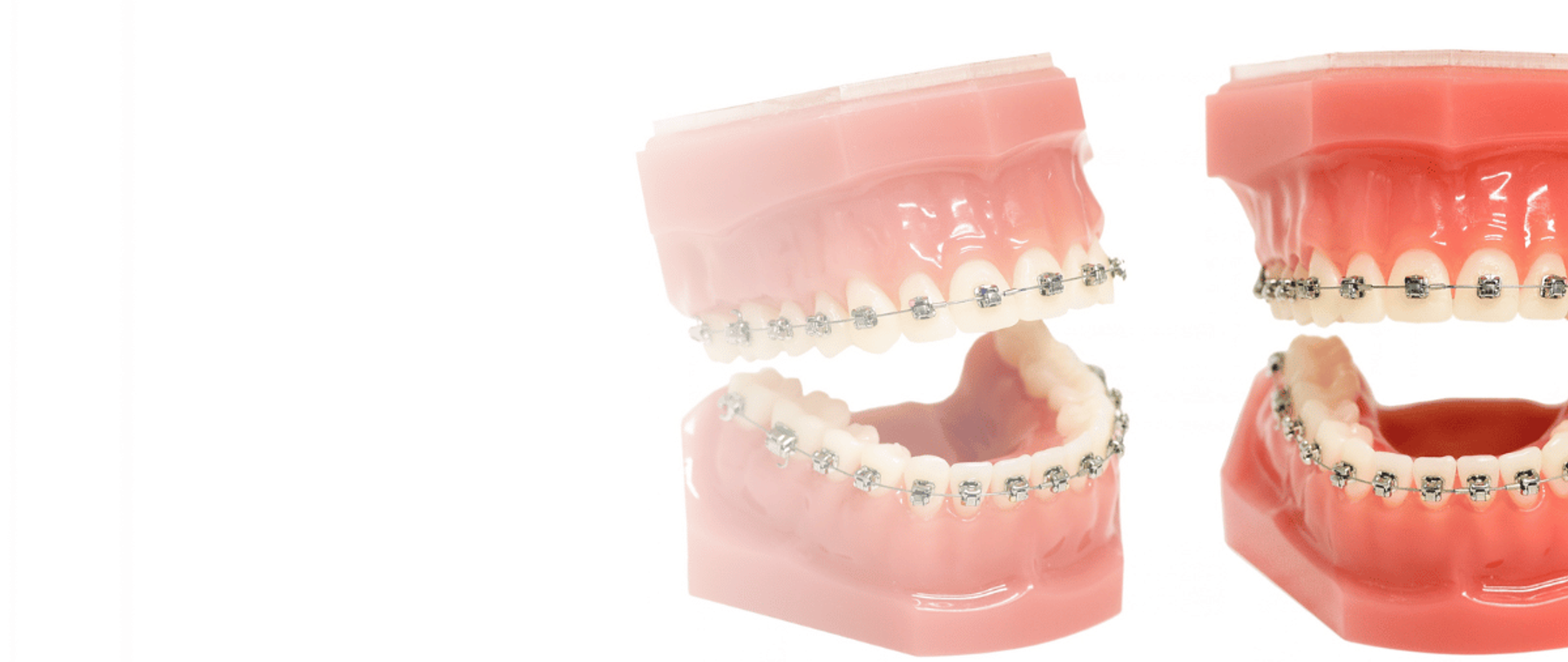
- Metal braces. The strongest and most cost-effective option, and still the standard for complex crowding. Modern brackets are considerably smaller than the ones people remember.
- Ceramic braces. Tooth-colored brackets that blend in at conversational distance. More discreet, slightly more fragile, and they need care with staining foods.
- Self-ligating braces. A sliding clip replaces the elastic tie. They can mean fewer adjustment visits, which is worth considering if you travel or work long hours.
- Lingual braces. Fitted behind the teeth so they do not show from the front. The most discreet fixed option, with a longer adjustment period for speech.
How long will I be in braces?
For crowding alone, most cases run somewhere between 12 and 24 months. What moves that number:
- How many millimeters of space have to be created
- Whether the bite needs correcting as well as the alignment
- Bone response, which is simply slower in some adults
- Whether appointments are kept, since skipped adjustments add months
- Breakages from hard or sticky food
Adults are sometimes told their treatment will take far longer than a teenager's. In practice the difference is usually modest for straightforward crowding.
What your first three visits look like at DentoCorrect
- Consultation and records. A full examination, photographs, and a scan or impressions. We measure the crowding rather than estimate it, and discuss what each option would mean for your case.
- Treatment plan and quote. You receive a written plan with the expected duration and an itemized cost before anything is fitted. Any gum treatment or fillings needed first are flagged here.
- Fitting. Brackets are bonded and the first wire placed. This takes roughly an hour and is not uncomfortable at the time, though the teeth usually feel tender for three to five days afterward as they begin to move.
Adjustments then follow every four to eight weeks depending on the system used.
When braces are not the right answer, or not yet
Being straight with patients about this matters more than winning the case:
- Active gum disease. Moving teeth through inflamed, infected tissue can worsen bone loss. This is treated and stabilized first, without exception.
- Untreated decay. Fillings come before brackets.
- Inconsistent oral hygiene. Braces make cleaning harder, not easier. If plaque control is already struggling, we address that first rather than build a problem.
- Unwillingness to wear retainers. Teeth drift back. A patient who will not retain the result is better served by not starting.
- Very mild crowding with no functional issue. Sometimes monitoring is the honest recommendation.
The part people skip: retainers
Almost every case of "my braces failed" that we see is actually a retention failure. Teeth have a memory, and the fibers around them pull toward the old position for years. Expect either a thin wire bonded behind the front teeth, a removable retainer at night, or both, essentially indefinitely. It is a small ongoing commitment that protects a significant investment.
Teeth braces in Lahore at our Gulberg, Johar Town and DHA clinics
We run three clinics across the city, so adjustment visits do not have to mean crossing Lahore:
- DentoCorrect Gulberg — 28K Sir Syed Rd, Block K Gulberg 2. Call [+92 347 4624067](tel:+923474624067). Convenient for Gulberg, Garden Town, Model Town and Shadman.
- DentoCorrect Johar Town — 7N Main Blvd, Block N Phase 2 Johar Town. Call [+92 314 2484555](tel:+923142484555). Convenient for Johar Town, Wapda Town, Valencia and Emporium.
- DentoCorrect DHA Phase 4 — 159, 1st Floor, near S. Abdullah, DHA Phase 4 Sector CCA. Call [+92 349 2807700](tel:+923492807700). Convenient for DHA, Cantt and Askari.
All three are ISO certified and staffed by PMDC-registered dentists. You can see full details and directions on our Lahore dental clinic page. If a crowded tooth has already chipped or worn, our guide to dental crowns in Lahore may also be useful.
What braces cost in Lahore
DentoCorrect keeps pricing consistent across every clinic, starting from:
- Metal braces — PKR 220,000
- Ceramic braces — PKR 250,000
- Self-ligating braces — PKR 350,000
For context, published prices across Lahore in 2026 commonly run from about PKR 150,000 to PKR 400,000 depending on the type of appliance and the complexity of the case. Quotes at the lower end often cover the appliance only, so it is worth asking what a figure includes.
Our price covers the full course of treatment: records, fitting, routine adjustments, removal and your first retainer. The consultation is free, and you receive an itemized quote in writing before committing. Monthly installment plans are available.
Frequently Asked Questions
Can I get braces at 35 or 40?
Yes. Teeth move at any age because the biology that allows movement does not switch off. Adults make up a growing share of orthodontic patients. The main requirements are healthy gums and sound teeth, not a particular birthday. Treatment time for straightforward crowding is usually similar to a teenager's.
Do braces hurt?
Fitting them does not hurt. The teeth usually ache for three to five days afterward, and for a day or two after each adjustment, because the bone around them is remodeling. Most people manage with ordinary paracetamol and softer food. Any sharp irritation from a bracket is easily fixed with orthodontic wax.
Will braces ruin my tooth enamel?
Not when hygiene is maintained. The white marks occasionally seen after treatment are early decay from plaque left sitting around brackets, not damage from the braces themselves. Brushing after meals, using interdental brushes and keeping scaling appointments prevents this in almost every case.
Can I fix just my front teeth more cheaply?
Sometimes, but be cautious. Short-term cosmetic alignment can tidy the front teeth while leaving the underlying bite untouched, and that can relapse or create new problems. Your dentist will tell you honestly whether a limited approach is appropriate for your case or simply a cheaper disappointment.
How often will I need appointments?
Typically every four to eight weeks, each taking fifteen to thirty minutes. Self-ligating systems sometimes allow longer intervals. Missing appointments is the most common reason treatment overruns, so it is worth choosing whichever of our three Lahore clinics you can reach easily.
Will my teeth move back afterward?
They will try to. That is why retainers are part of treatment rather than an optional extra. With a bonded wire behind the front teeth or a night-time retainer worn consistently, the result holds well. Without retention, some relapse within a few years is likely.
Book a braces consultation in Lahore
If your teeth have been crowding slowly for years, an assessment costs you nothing and ends the guesswork. We will measure the crowding, show you what is causing it, and set out the realistic options with honest timelines.
Call [+92 314 2484555](tel:+923142484555) or book an appointment online at our Gulberg, Johar Town or DHA Phase 4 clinic. You can also read more about braces treatment at DentoCorrect.