Dentures in Peshawar: New Teeth, Renewed Confidence for Seniors
Most families who ask us about dentures in Peshawar do not open with teeth. They say their father has stopped eating with everyone else, or their mother pushes the meat to the side of the plate and fills up on bread and chai instead. The teeth are the cause; the loss of appetite, the weight, and the willingness to sit at a table with guests are what actually changed. That is the problem worth solving, and it is worth being honest about how much of it a denture fixes and how much it does not.
Signs Missing Teeth Are Already Costing More Than a Smile
Look for these rather than waiting for a complaint:
- Meat, apples and raw salad quietly leaving the plate while bread, rice and chai increase
- Eating alone, or after everyone else has finished
- Chewing only on one side, or for much longer than before
- Weight coming off without any change in appetite being mentioned
- A hand over the mouth while talking or laughing
- Speech that has changed — whistling on s sounds, or words running together
- A face that looks shorter, with the chin closer to the nose and deeper lines at the corners of the mouth
That last one is not vanity. It is the jawbone shrinking, and it changes what a denture can achieve later.
The Foods That Quietly Disappear From the Plate
This is the part most denture discussions skip. The foods that need real chewing — tough meat, raw vegetables, whole fruit, nuts — are the same ones carrying protein, iron and most micronutrients. When chewing gets difficult those foods go first, and what replaces them is softer and starchier.
Research on older adults links chewing difficulty to measurably poorer diet quality, and people without teeth who do not wear dentures are the group most exposed to it. For an elderly parent already eating less than they should, that matters more than the appearance of the gap.
What Dentures Actually Restore, and What They Do Not
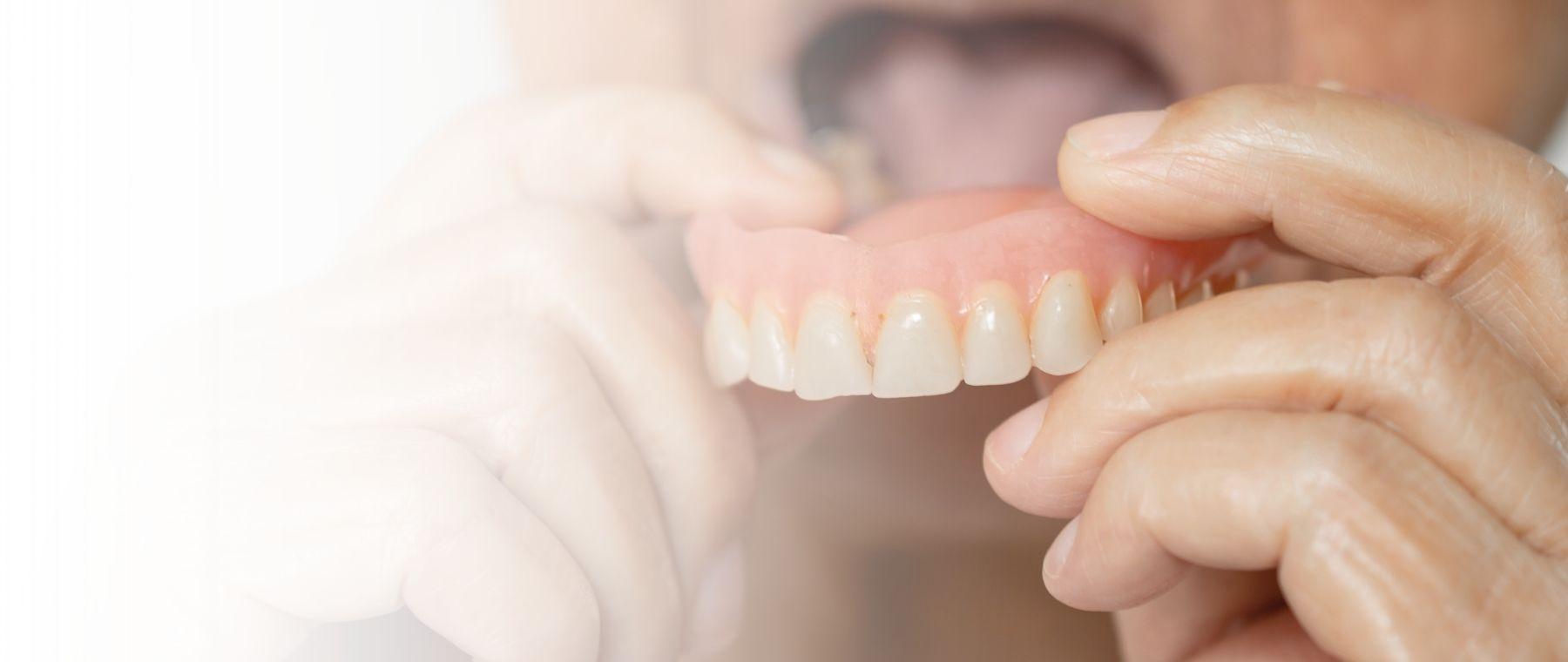
A denture is a removable replacement for missing teeth and the gum around them, made to fit the shape of your own ridges. A complete denture replaces a whole arch; a partial fills gaps and clasps onto the teeth you still have.
Being straight about the outcome:
- Chewing ability improves, particularly for people who have lost some but not all of their teeth, and the evidence supports that
- Enjoyment of eating improves, which is often the change families notice first
- Appearance and speech usually improve, because the denture restores the height of the face
- Chewing does not return to what natural teeth did. Studies find denture wearers still take in less of the hard-to-chew, nutrient-dense foods than people with their own teeth
So the honest promise is a large improvement, not a reversal. A patient who expects to bite into a seekh kebab the way they did at thirty will be disappointed; one who expects to eat with the family again, comfortably, usually is not.
Why the Jaw Keeps Changing After the Teeth Are Gone
The bone that held your teeth existed to hold your teeth. Once they go, it slowly shrinks, fastest in the first year and continuing for decades. This has three consequences worth knowing before you choose:
- A denture that fits beautifully today will loosen over the years, because the ridge beneath it is changing, not because the denture was badly made.
- Waiting years before replacing teeth means less bone to seat a denture on, and a flatter ridge holds a denture less securely.
- Lower dentures suffer most, because the lower ridge is smaller and the tongue works against it.
If your parent's denture has already gone loose, relining is usually the answer rather than a whole new set, and our guide to loose dentures in Rawalpindi explains the options.
Choosing Between a Partial and a Complete Denture
- Acrylic partial denture. Fills gaps, rests on the gum and clasps to remaining teeth. The most affordable, and straightforward to add to if another tooth is lost later.
- Cast metal partial. A slimmer metal framework. More comfortable and more precise, and it transmits chewing force through the remaining teeth rather than the gum.
- Flexible partial. Gum-colored nylon, no metal clasps showing. Comfortable and discreet, though it cannot be relined as easily.
- Complete acrylic denture. For a full arch, shaped to restore face height and lip support.
- Implant-retained denture. Two or more implants with clips holding the denture down, which solves the loose-lower-denture problem better than anything else. Our guide to dental implants covers what is involved.
For an older patient with several teeth still sound, keeping those teeth and fitting a partial is almost always better than clearing the arch for a complete denture. Natural roots preserve bone.
Do Dentures Change How Food Tastes?
An upper denture covers the palate, which does slightly dull the sensation of food, and many people notice hot and cold less for the first few weeks. Actual taste buds sit on the tongue and are unaffected. Most patients adapt within a month. Keeping the denture clean matters here, because a film on the acrylic genuinely does affect taste.
The Adaptation Weeks Nobody Warns You About
New dentures feel wrong before they feel right, and knowing the sequence prevents a drawer full of unworn dentures:
- Week one: bulky, extra saliva, some gagging with an upper denture. Soft food, small pieces, both sides at once.
- Weeks two to three: sore spots appear where the denture presses. These need adjusting at the clinic, not enduring. Two or three visits is normal, not a sign of poor work.
- Weeks three to six: speech settles. Reading aloud for ten minutes a day genuinely speeds this up.
- Two to three months: chewing confidence returns, and harder foods come back gradually.
Tell an older patient this in advance. The ones who give up usually do so in week two, believing the denture failed when it simply needed adjusting.
When a Denture Is Not the Best Answer
- A single missing tooth. A bridge or an implant is usually more comfortable and more stable.
- Severely shrunken lower ridge. A conventional lower denture may never be stable; implants to retain it are the honest recommendation.
- Active gum disease or untreated decay. Treated and stabilized first, always.
- Dry mouth from medication. Common in older patients and it makes dentures rub. It needs managing alongside, not ignoring.
- A patient who cannot manage the cleaning. If dexterity or memory makes daily removal and cleaning unrealistic, a fixed option or a carer routine has to be part of the plan.
Dry mouth and gum health are also why a scaling appointment often comes first; our guide to scaling and polishing in Peshawar covers that.
Your Appointment at DentoCorrect, Visit by Visit
- Assessment. Examination of the ridges, remaining teeth and gums, with X-rays where needed, and a discussion of partial versus complete versus implant-retained.
- Impressions. Two stages — a first impression, then a precise one taken in a custom tray, which is what makes the difference between a denture that grips and one that does not.
- Bite registration and try-in. You see the teeth set in wax and approve the shade, shape and face height before anything is finished. Bring a family member; a second opinion on the look is useful.
- Fitting. The finished denture is seated and the bite adjusted.
- Adjustments. Reviews at a few days and a few weeks to settle sore spots.
Our Ring Road clinic is ISO certified, and we schedule older patients earlier in the day when they are least tired.
Keeping a Denture Comfortable for Years
- Take it out at night and store it in water, not in a dry case
- Clean it over a basin of water, so a drop does not crack it
- Brush it with a soft brush and mild soap or denture cleaner, never toothpaste
- Clean the gums and tongue daily too, even with no teeth left
- Come back yearly: the ridge changes, and a reline every few years is normal
- Never attempt a repair with glue; a fracture realigned badly ruins the fit
Dentures in Peshawar at Our Ring Road Clinic
DentoCorrect Peshawar — Shop No. 8, Sami Tower, Hayatabad Toll Plaza, Ring Road. Call [+92 347 3709783](tel:+923473709783).
The clinic is convenient for Hayatabad, University Town, Warsak Road, Dalazak Road, Gulbahar and the Ring Road corridor, with on-site laboratory coordination so try-in appointments are not spread over weeks. Full directions are on our Peshawar dental clinic page. Our complete denture guide for Karachi covers full-arch cases in more depth.
How Much Does a Denture Cost in Peshawar?
At DentoCorrect a complete denture starts from PKR 70,000 and a flexible denture from PKR 150,000, with the consultation free. The figure depends on the arch, the material and how many teeth are replaced, and you receive a written plan before anything begins.
For context, published prices across Pakistan in 2026 commonly run from about PKR 50,000 to PKR 120,000 per arch for acrylic complete dentures, PKR 60,000 to PKR 90,000 for cast metal partials, and PKR 70,000 to PKR 150,000 for flexible dentures. Implant-retained options cost considerably more.
Ask any clinic whether a quote includes the custom-tray impression, the try-in stage and the follow-up adjustments. A cheaper denture made from a single quick impression with no try-in is the most common reason a denture ends up in a drawer, and it is not a saving.
Frequently Asked Questions
Will dentures change the shape of my face?
They should improve it. Once teeth are lost the face shortens and lines deepen at the corners of the mouth, and a well-made denture restores that height and lip support. Teeth set too long or too full look obviously artificial, which is why the wax try-in stage exists for you to approve.
Why do I gag with a new upper denture?
Because the palate is not used to being covered, and the brain treats it as something to expel. It usually settles within one to two weeks. If it persists, the back edge of the denture may be slightly too long or too thick and can be trimmed, so mention it rather than enduring it.
Can I still eat naan and tough meat with dentures?
Naan yes, with practice, torn into pieces rather than bitten through with the front teeth. Tough meat is the hardest category and many patients never fully return to it with a conventional denture. Mince, slow-cooked meat and karahi-style dishes are usually comfortable. Implant-retained dentures cope considerably better.
Is toothpaste safe for cleaning dentures?
No, and this surprises people. Ordinary toothpaste is abrasive enough to scratch denture acrylic, and those scratches hold stain and bacteria. Use a soft brush with mild soap or a proper denture cleaner, and soak as your dentist directs. Never use hot water, which can warp the fit.
Do my remaining teeth have to come out?
Usually not, and keeping them is normally better. Natural roots preserve the jawbone and give a partial denture something firm to hold onto. Teeth only come out if they are loose from gum disease, badly decayed, or sitting where they would make a stable denture impossible. Your dentist should justify each one.
Will my speech change?
Briefly. Words with s and sh sounds are the usual difficulty, and most people sound normal again within two to four weeks. Reading aloud daily shortens that noticeably. If a whistle or lisp persists beyond a month, the denture's shape can be adjusted rather than simply accepted.
Book a Denture Consultation in Peshawar
If an older family member has started eating alone or leaving the meat on the plate, the problem is already affecting more than their smile. An assessment costs nothing and tells you honestly which option fits their mouth and their routine.
Call [+92 347 3709783](tel:+923473709783) or book an appointment online at our Ring Road clinic. You can also read more about dentures and partial dentures at DentoCorrect.