What Is an Impacted Tooth?
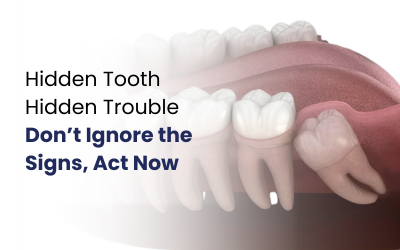
Have you ever noticed a dull, nagging pain at the back of your mouth that appears without warning then disappears and comes back again later? These are often early signs of an impacted tooth, a condition that can quietly develop over time without obvious symptoms over time. An impacted tooth is not simply a “delayed tooth.” It is a tooth that is unable to properly erupt in the mouth and remains trapped under the gum or bone.
Understanding Tooth Impaction
An impacted tooth occurs when a tooth fails to emerge fully into the dental arch. Instead of aligning with the other teeth, it remains stuck partially or completely beneath the gum line. This condition is referred to as tooth impaction.
How does this actually happen?
In a normal situation, teeth erupt in a predictable sequence. But in cases of impaction:
- The tooth may be blocked by another tooth
- The jaw may not have enough space
- The tooth may be angled incorrectly from the start
- Eruption timing may be delayed or disrupted
As a result, the tooth becomes “trapped” and cannot complete its natural path.
What does this mean for you?
Even if it does not cause immediate pain, an impacted tooth can silently create tight spaces where bacteria accumulate, increasing the risk of gum problems and decay in nearby teeth.
Types of Impacted Tooth
Tooth impaction varies from person to person and does not always present in the same way. It depends on how much the tooth has erupted and its position in the jaw. Some teeth partially emerge, while others remain completely hidden under the gum or bone, often without obvious symptoms at first.
1. Based on position
The way a tooth is positioned plays a major role in how it behaves.
- In vertical impaction, the tooth is almost upright but cannot fully erupt due to lack of space.
- In horizontal impaction, the tooth grows sideways and may push against nearby teeth, creating pressure.
- In angular impaction, the tooth erupts at an incorrect angle, which can disturb alignment and crowd surrounding teeth.
The deeper or more misaligned the impacted tooth is, the higher the chance of discomfort, pressure, difficulty cleaning, and long-term dental issues. Even without severe pain, it can silently affect nearby teeth and gum health over time
2. Based on visibility
An impacted tooth can either be partially visible or completely hidden.
- A partially impacted tooth only breaks through the gum slightly, often leading to food trapping, gum irritation, and difficulty in cleaning.
- A fully impacted tooth stays completely beneath the gum or bone and is usually discovered during an X-ray, as it does not appear in the mouth.
- Impacted wisdom tooth (Third Molars): An impacted wisdom tooth occurs when the third molars do not have enough space to erupt properly at the back of the mouth. These teeth typically emerge between the ages of 17 and 21. An impacted wisdom tooth often begins with a mild, dull ache that may come and go, making it easy to overlook initially. Over time, the discomfort can spread toward the jaw, ear, or temple, especially during chewing or brushing.
- Impacted canine tooth (Eyeteeth): An impacted canine tooth happens when the upper canine (eye tooth) fails to erupt and remains trapped in the gum or bone. It is often noticed when a baby tooth stays longer than expected or when a permanent tooth never appears in its expected position.
- Second Premolars: Third most common, often due to crowding or early loss of primary teeth.
DentoCorrect Clinic provides comprehensive evaluation using modern diagnostic tools to accurately identify tooth impaction and guide appropriate treatment planning.
Early Signs of an Impacted Tooth
Not all impacted teeth cause immediate discomfort. Many cases are discovered during routine dental examinations. However, common warning signs include:
- Dull, persistent jaw pain
- Pain radiating to the ear or temple
- Swollen or tender gums
- Difficulty opening the mouth fully
- Food repeatedly getting stuck in one area
- Bad breath despite good hygiene
- Headaches without a clear cause
These symptoms often develop gradually. Because they are mild at first, many people delay seeking care until the condition progresses.
Treatment Options for Impacted Teeth
Treatment depends on the type, position, and severity of impaction.
1. Monitoring: If the impacted tooth is not causing symptoms or damage, it may simply be monitored over time.
2. Surgical removal: This is commonly recommended for an impacted wisdom tooth, especially if it is causing pain, infection, or pressure on nearby teeth.
3. Orthodontic treatment: For an impacted canine tooth, orthodontic intervention may be used to guide the tooth into its proper position. With modern dentistry, treatment is more predictable, comfortable, and minimally invasive than in the past.
What Happens If an Impacted Tooth Is Left Untreated?
Ignoring tooth impaction can lead to a gradual progression of complications, such as:
- Recurrent gum infections
- Decay in adjacent healthy teeth
- Formation of cysts around the impacted tooth
- Increased pain and swelling over time
- Difficulty chewing or jaw movement issues
In more advanced cases, it may even affect overall bite alignment and oral health stability. Waiting until discomfort becomes severe can make treatment more complex. Early care is always the better choice
Final Thoughts
An impacted tooth may begin silently, without obvious symptoms. However, over time, it can lead to discomfort, infection, and alignment problems if not addressed early. The key is awareness- recognizing small signs before they become bigger concerns. If you’ve been experiencing jaw discomfort, swelling, or unexplained dental pressure, it is worth getting it checked.
Early diagnosis can make a significant difference in treatment simplicity and long-term oral health. DentoCorrect Clinic can help you understand whether your symptoms are related to tooth impaction and guide you toward the right treatment plan. A timely evaluation today can help prevent complications tomorrow.
Disclaimer
This article is for informational purposes only and does not replace professional dental advice, diagnosis, or treatment. Always consult a qualified dentist for personalized care.